If you’ve worked with PCBs for any length of time, you’ve almost certainly come across FR-4. It’s been the workhorse of the electronics industry for decades—cheap, easy to source, and compatible with most standard manufacturing processes. As an FR-4 PCB supplier who’s been in this space for over 12 years, I’ve sold thousands of these boards, and I’ve helped clients from startup engineers designing their first prototype to senior teams at Fortune 500 companies troubleshoot issues with their designs. FR-4 is far from perfect, though. I’ve seen its limitations derail production runs, increase end-product failure rates, and even force teams to scrap entire batches of boards. Today, I want to talk honestly about the disadvantages of FR-4 PCBs—straight from a supplier who lives with this material’s ups and downs every single day. FR4 PCB
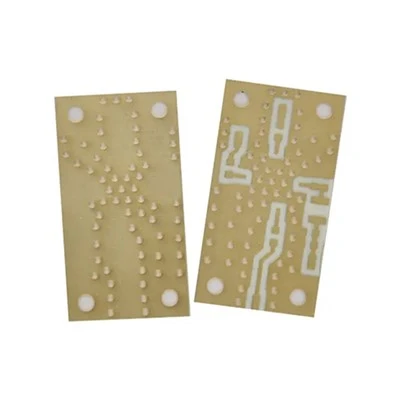
Let’s start with the basics for anyone who might be new to this: FR-4 is a flame-retardant composite made from woven glass fiber cloth embedded in an epoxy resin matrix. The “FR” stands for flame retardant, a key safety feature for most consumer and industrial electronics. But that epoxy and glass mix is where most of the tradeoffs come from. The first big disadvantage that comes up time and time again is heat resistance limitations. Epoxy resins, the binder that holds the glass together, start to break down at temperatures well below what many modern designs require. Most standard FR-4 has a glass transition temperature (Tg) of around 130°C to 140°C. Tg is the point where the resin stops acting like a rigid solid and starts to soften, which is a huge problem for PCBs.
Think about a power supply board that’s designed to run 24/7 pulling high current, or a motor driver that sits near a heat-generating component. At sustained temperatures above 140°C, the FR-4 resin softens, which leads to two critical issues. First, the copper traces laminated to the PCB can start to delaminate—separate from the substrate. I’ve had a client send back a batch of automotive PCBs last year where the boards started delaminating after just 500 hours of operation under load. They were using standard FR-4 with a 130°C Tg, and the motor’s heat pushed the board right past that threshold. The second issue is trace expansion. When the resin softens, it expands at a different rate than copper, causing micro-cracks in the traces. Those cracks don’t always show up in initial testing, but they can develop after the product ships, leading to field failures that are a nightmare to track down.
And it’s not just sustained heat. Standard soldering processes use lead-free solders that melt at around 217°C, which is 70 degrees higher than older leaded solders. When you’re reflow soldering a batch of boards, the peak temperature during reflow is often pushed to 260°C to 270°C to ensure the solder flows properly. That’s way above FR-4’s Tg. I’ve seen this cause voiding between the resin and glass, or even blistering on the PCB surface when the moisture trapped in the substrate boils at that high temperature. Clients will often ask, “Can’t we just use high-Tg FR-4?” And yes, that’s a solution—high-Tg FR-4 can go up to 180°C, which helps, but it’s still epoxy-based, so it doesn’t solve the fundamental problem of epoxy’s inherent heat limitations. For applications that regularly see temperatures above 180°C, there’s only so much you can tweak with standard FR-4.
Next up, mechanical limitations. FR-4 is a rigid material, which is fine for most consumer PCBs, but it’s terrible for applications that require flexibility. Wearables, foldable displays, flexible sensors, or even some automotive under-hood components that vibrate a lot—FR-4 can’t bend repeatedly without breaking. I once worked with a startup designing a flexible fitness tracker that used a standard FR-4 board, and within two weeks of testing, the traces cracked right where the board bent around the wrist. They had to switch to a flexible polyimide (PI) substrate entirely, and the difference was night and day. But that comes at a much higher cost, which is why a lot of designers try to shoehorn FR-4 into flexible applications first—only to run into problems.
Even for rigid applications, FR-4 has weaknesses under mechanical stress. The woven glass fiber gives it some structural strength, but it’s prone to cracking under impact or extreme vibration. I’ve had industrial clients send back PCBs that failed during drop testing—standard FR-4 doesn’t have the impact resistance of tougher materials like aluminum or polycarbonate-backed PCBs. Vibration is another big one: in heavy machinery or aerospace applications, constant vibration can cause the solder joints to fatigue, and the FR-4 substrate to develop cracks that propagate over time. Unlike metal core PCBs (MCPCBs) that dissipate heat better or even flexible substrates that handle mechanical stress, FR-4 can’t stand up to heavy mechanical use without modifications, and even then, it has limits.
Moisture absorption is another underrated disadvantage of FR-4. The epoxy resin matrix is porous, which means it can absorb moisture from the air, especially in high-humidity environments. That might not sound like a big deal, but it causes two major issues. First, when you expose a moist FR-4 PCB to high temperatures—like during reflow soldering or a high-heat operating environment—the trapped moisture expands, leading to blistering, delamination, or even what’s called “popcorning,” where the board’s layers separate so violently it sounds like popcorn popping. I remember a batch of medical device PCBs a few years ago that failed popcorning during reflow. The client had stored the boards in a warehouse with high humidity for two months before manufacturing, and the moisture in the FR-4 caused the issue.
The second problem with moisture absorption is electrical performance. When FR-4 absorbs water, its dielectric properties degrade. Dielectric strength, which is a measure of how well a material insulates, drops significantly when the material is wet. That means higher risk of short circuits, especially in high-voltage applications like power grids or industrial control systems. For outdoor electronics that sit in rain or high humidity for years, FR-4’s moisture absorption can lead to long-term corrosion of copper traces too. I’ve seen field failures in streetlight controllers where the copper traces corroded from moisture seeping into the FR-4 substrate, even with a conformal coating. The coating only does so much if the board’s core is absorbing water.
Wait, let’s talk about electrical limitations too. FR-4 isn’t a perfect insulator, especially at high frequencies. For RF (radio frequency) and high-speed digital designs—like 5G antennas, high-speed USB 3.0, or radar systems—FR-4’s dielectric constant (Dk) is inconsistent and changes with frequency and temperature. Standard FR-4 has a Dk of around 4.2, but that can vary by as much as 10% between batches, and it drops as frequency increases above 1 GHz. That inconsistency is a huge problem for high-speed designs, because it leads to signal loss, impedance mismatch, and data corruption. I had a client designing a 5G base station antenna that was getting terrible signal quality, and it turned out their prototype used standard FR-4 which had a variable Dk that caused the antenna’s impedance to be off. They had to switch to a high-frequency material like Rogers or Teflon, which are way more stable at high frequencies—though again, at a much higher cost.
Also, for high-voltage applications above a few thousand volts, FR-4’s dielectric strength is lower than specialized high-voltage substrates. The porous structure of the material means there are tiny gaps and voids where electrical breakdown can occur. That leads to flashovers or short circuits, which are dangerous in applications like power transformers or high-voltage inverters. I once worked with a solar inverter manufacturer who tested FR-4 boards for their high-voltage side, and they had 12% failure rates during dielectric withstand testing, because the FR-4 couldn’t handle the 1500V test voltage without breaking down. They switched to a ceramic-based high-voltage PCB substrate, and failure rates dropped to near zero, but that’s a more expensive alternative.
Then there’s the environmental and disposal aspect, which is something a lot of people don’t talk about, but it’s a real disadvantage of FR-4 compared to newer materials. FR-4 is not biodegradable, and its manufacturing process uses epoxy resins that release volatile organic compounds (VOCs). The biggest issue, though, is that when FR-4 PCBs are incinerated or end up in landfills, they release toxic chemicals like bromine, antimony, and lead—from the flame retardants and trace metals. I’ve worked with electronics companies that are required to follow RoHS or REACH regulations, and FR-4 can be tricky because some older batches use brominated flame retardants (BFRs) which are restricted in many regions. Even non-BFR FR-4 is harder to recycle than other materials because of the composite structure—you can’t easily separate the glass fiber and epoxy, so most FR-4 PCBs end up in landfills or are processed with energy-intensive methods that aren’t great for the environment.
I know a lot of engineers will say, “But FR-4 is cheap!” And that’s true—for general-purpose applications, it’s hard to beat FR-4’s balance of cost and performance. But that doesn’t mean it’s the right choice for every project. As a supplier, I see clients try to use FR-4 for applications where it’s never going to work, and that leads to wasted time, money, and materials. For example, a startup designing a satellite component that has to handle extreme temperature swings would be better off with a polyimide or ceramic substrate, not FR-4. A company making a wearable fitness tracker that needs to bend with the user’s wrist shouldn’t use rigid FR-4. It’s not that FR-4 is bad—it’s just that it’s a material with specific limits, and not every design fits within those limits.
Let me be clear: I’m not bashing FR-4. I’ve sold FR-4 PCBs to hundreds of clients over the years, and most of them work perfectly. It’s the best option for 90% of the consumer electronics, industrial control boards, and low-power devices that make up the bulk of the PCB market. But the disadvantages I’ve outlined—heat resistance limits, mechanical rigidity, moisture absorption, high-frequency electrical instability, and environmental disposal challenges—are very real, and they’re the reason I always work with clients to match the right material to their application. If a client comes to me with a design that runs at high temperatures, needs flexibility, or uses high-speed signals, I’ll never push FR-4 if a better material is a good fit, even if it costs more up front. As a supplier, my job isn’t just to sell a cheap board—it’s to make sure the client’s product works as intended, and that means being honest about FR-4’s flaws.

If you’re designing a new PCB and you’re not sure whether FR-4 is the right material for your project, or if you’ve been dealing with issues from FR-4’s limitations, I’d love to help. I’ve worked with designs ranging from simple hobby boards to complex industrial and medical devices, and I can walk you through the pros and cons of every material option, including FR-4, to find the best fit for your needs. Feel free to reach out to discuss your PCB requirements and find a solution that works for you.
Single Layer FR4 PCB Board References
IPC-4101/22, Generic Specification for Unclad and Clad Laminates for Printed Board Manufacturing, Part 22: Flame Retardant Woven Glass Fabric Reinforced Epoxy Laminates (FR-4)
"High Frequency PCB Materials: A Comparison of FR-4, Rogers, and Teflon", Journal of Electronic Materials, 2019
"Moisture Absorption Effects on FR-4 PCB Performance", IEEE Transactions on Components, Packaging, and Manufacturing Technology, 2017
"Mechanical Reliability of FR-4 PCBs Under Vibration and Impact Loading", International Journal of Microelectronics and Electronic Packaging, 2020
Environmental Protection Agency (EPA) Report on Electronic Waste: Toxic Components and Disposal Challenges, 2021
Fastline Circuits Co., Limited
Fastline Circuits Co., Limited is one of the most professional FR4 PCB manufacturers and suppliers in China. With abundant experience, we warmly welcome you to wholesale durable FR4 PCB made in China here and get quotation from our factory. All customized products are with high quality and competitive price.
Address: Room 301, Building B3, Fuqiao 4th District, Qiaotou Community, Fuhai Subdistrict, Bao’an District, Shenzhen, Guangdong Province, China
E-mail: sales@fastlinepcb.com
WebSite: https://www.fastlinepcb.net/
