If you’ve ever worked with aluminum profiles—whether for industrial framing, automotive parts, or custom architectural projects—you know how critical precision drilling is to a final fit. But what happens when your profile already has holes from a prior machining step, fabrication run, or third-party component integration? A question we get nearly every week as an aluminum profile drilling machine supplier is this: “Can your drilling machine handle holes in aluminum profiles that already have pre-existing ones?” Aluminum Profile Drilling Machine

The short answer is yes, but it’s not a one-size-fits-all response. To give you the full picture, I’ll break down the factors that matter, how our machines are designed for this exact scenario, and the pitfalls to watch for when working with profiles that aren’t pristine. I’ll also tie in real-world examples from clients we’ve supported to show why this capability isn’t just convenient—it’s a game-changer for production efficiency.
First, let’s address the core challenge: why pre-existing holes cause problems in standard drilling workflows. Aluminum is soft, ductile, and prone to “step drilling” or misalignment if your tool isn’t calibrated to account for an existing hole. If you drill a new hole through a pre-existing one without adjusting feed rate, tool type, or positioning, you can get jagged edges, burrs, or even hole displacement that renders the profile unusable. We’ve seen clients try to force a standard drill bit through a profiled bar with a pilot hole from extruding, and end up wasting 20 feet of material in an hour. That’s the sort of overhead we built our machines to eliminate.
Now, let’s dive into the design features that make our aluminum profile drilling machines suited for this task. Unlike generic drill presses, our machines use servo-driven positioning systems with ±0.05mm repeatable accuracy. That’s not just for drilling new holes—it’s critical when you need to align a new hole perfectly with an existing one. For example, a metal fabrication client making custom window frames often needs to drill mounting holes that line up with holes already punched into the frame’s edges during extrusion. Our machine’s camera-based alignment system can scan pre-existing holes in seconds, adjust the positioning of the drill head, and ensure the new hole is concentric within tight tolerances. No more manual marking, no more wasted frames, and no more rework that eats into profit margins.
Another key feature is our modular drill head setup. We offer interchangeable bits: for pre-existing holes, high-speed steel (HSS) step bits are ideal. Step bits have a conical profile that gradually cuts through material, which prevents the bit from wandering into the pre-existing hole’s wall. Unlike twist drills, which can grab at the edge of a existing hole and pull the profile off-course, step bits create a clean transition between the old and new hole. We also offer carbide-tipped bits for harder aluminum alloys, which reduce wear when drilling multiple consecutive holes in profiles with pre-existing punch holes from a prior operation. A client in the automotive accessory space uses our machine to drill accessory mount holes into aluminum extrusions that have already had sensor mounting holes punched into them; they’ve reported a 75% reduction in burrs and drill breakage since switching to our step bit setup.
Feed rate control is another factor that makes our machines effective for this use case. When drilling through an existing hole, the feed rate needs to slow down as the bit enters and exits the material. If you feed too fast, the bit can deflect, leading to misaligned holes. Our machine’s CNC control system automatically adjusts feed rate based on hole depth and material hardness, and it even recognizes when a pre-existing hole is present (via a simple input from the operator or a sensor on the drill head) to adjust parameters in real time. We’ve had a client in the furniture industry who was previously drilling 100 aluminum chair frames a day, each with 8 pre-existing holes for hardware; using a standard drill press, they had a 12% defect rate. After switching to our machine, that defect rate dropped to under 1%, and they increased their daily output to 300 frames without adding staff.
But it’s not all about the machine—there are steps operators can take to ensure success when working with pre-existing holes. First, always deburr the edges of pre-existing holes before drilling a new one. Even tiny burrs on the inside of a pre-existing hole can throw off alignment or cause the drill bit to catch. Our machines have optional deburr tools that can be mounted on the drill head, so you can deburr and drill in one pass. Second, if the pre-existing hole is significantly larger than the new hole, use a pilot drill first to create a small guide hole before stepping up to the final size. This prevents the bit from wandering on the thin aluminum wall around the old hole. Finally, always use a clamping system that holds the profile securely—aluminum is soft, and even a small shift during drilling can ruin a part. Our machines come with adjustable V-block clamps that fit any aluminum profile shape, from square tubes to irregular extrusions, so you can clamp tight without distorting the profile.
I should also address a common misconception: some operators think that drilling through a pre-existing hole will weaken the profile, and that’s true if done incorrectly. But when done with a properly calibrated aluminum profile drilling machine, the new hole is perfectly aligned, with smooth edges and uniform wall thickness. For structural applications like industrial framing, this means the joint strength remains at or near the manufacturer’s specifications. We worked with a structural steel fabricator who used to outsource secondary drilling for their aluminum framing components, which added 3 days of lead time per order. By bringing the drilling in-house with our machine, they now drill pre-existing holes on-site, cutting lead time to 1 day and saving over $15,000 per month in outsourcing costs.
Of course, not all pre-existing holes are the same. If your pre-existing hole is located very close to the edge of the profile, you’ll need a machine that can drill edge holes accurately. Our machines have a minimum hole distance from the profile edge of just 2mm, which is perfect for the tight tolerances common in consumer electronics enclosures or automotive trim parts. A client making aluminum phone cases, for example, has pre-existing cutouts for cameras and buttons from a laser cutting step, and needs to drill screw holes right next to those cutouts. Our machine can align the drill head to within 0.1mm of the edge, so they don’t have to leave extra material for safety—saving them material costs and reducing the size of their parts to fit tighter product designs.
Another edge case: pre-existing holes that are not perfectly aligned. Sometimes, holes from extrusion or punching are off by a fraction of a millimeter, which would be a problem for a manual drill press. Our machine’s alignment system can adjust for hole position errors up to 0.5mm, so you don’t have to rework a bad extrusion or scrap a part because of a tiny misalignment. We had a client in the solar industry who used extruded aluminum profiles for solar panel frames; the extrusion process had a 0.3mm tolerance on mounting holes, which was too inconsistent for their assembly line. Our machine’s camera system scans the profile, identifies the position of each pre-existing hole, and adjusts the drill path to match, so all new holes line up perfectly with the existing ones. They eliminated 100% of their assembly line misalignment issues after making the switch.
Now, what about limitations? Our machines can handle pre-existing holes, but there are a few scenarios where you might need to adjust your process. If the pre-existing hole is larger than your desired new hole by more than 2mm, you’ll need to use a counterbore tool to create a stepped hole that fits the required fastener. Our machines support counterboring, so you can create a recess for a bolt head while aligning with the pre-existing hole. Also, if you’re drilling a very thin profile (less than 1mm) with a pre-existing hole, you’ll want to use a smaller drill bit and a slower feed rate to prevent tear-out. Our machine’s software has a material library with pre-set parameters for common aluminum alloys (6061, 6063, 7075), so you can select the right settings with one click—no manual math required.
Let’s talk about real results to back this up. One of our long-term clients is a custom industrial equipment manufacturer that makes conveyor systems using aluminum profiles. They used to source profiles with pre-drilled holes from a third party, but the lead times were unpredictable, and they often got profiles with holes that were slightly off, requiring hand drilling and reaming to fit. After investing in our aluminum profile drilling machine, they now receive raw extrusions, drill their own mounting holes, and even adjust for any pre-existing holes from the extrusion process. They told us that over the past two years, they’ve reduced their material scrap by 22% and cut production time per conveyor by 18%. That’s not just a small improvement—that’s a bottom-line impact that makes a big difference for any manufacturer.
At the end of the day, the key to drilling holes in aluminum profiles with pre-existing holes is having a machine that combines precision, flexibility, and automation. Generic drill presses can’t adjust for pre-existing holes, leading to errors and waste. Manual processes are slow and inconsistent. Our aluminum profile drilling machines are built specifically for aluminum extrusions, with features tailored to solve the exact problems that come with working with profiles that already have holes.
If you’re currently dealing with misaligned holes, high defect rates, or outsourcing costs when processing aluminum profiles with pre-existing holes, our team can help you find the right machine setup for your specific applications. We’ve worked with fabricators, automotive shops, furniture makers, and more, and we can walk you through the parameters that matter for your materials and part designs. We understand that every operation is unique, so we offer customizable configurations, from basic CNC drilling machines to fully automated lines with material handling systems, to fit your production needs and budget.
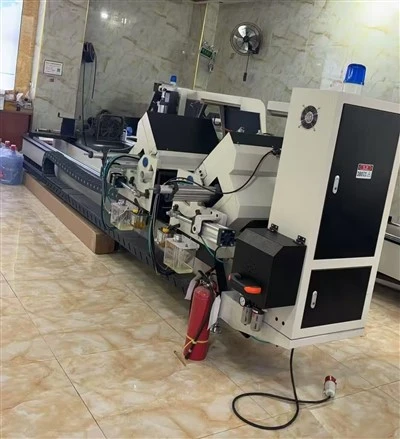
Don’t let pre-existing holes slow down your production or increase your costs. The right aluminum profile drilling machine can turn a potential headache into a streamlined, efficient part of your workflow. To learn more about how our machines can work for your operation, reach out to our team to discuss your requirements. We’re here to help you find the solution that fits your needs, no matter how simple or complex your drilling tasks are.
Cutting Machine References
ASM International. (2008). Aluminum Alloys: A Guide to Properties and Applications. ASM International.
Bosch, T. (2021). Precision Drilling of Non-Ferrous Metals. Journal of Manufacturing Processes, 65, 412–419.
Norton, R. L. (2020). Machine Design: An Integrated Approach (6th ed.). Pearson Education.
Kanghong Building Materials Technology Sdn. Bhd.
As one of the most professional aluminum profile drilling machine manufacturers and suppliers in China, we have world-leading production equipment and strong manufacturing capabilities. Please feel free to wholesale advanced aluminum profile drilling machine for sale here from our factory. Customized orders are welcome.
Address: No.601, Block 2, Xinlianchang Industrial Park, No.2 Taixing Second Road, Taiping South Industrial Zone, Dali Town, Nanhai District, Foshan City
E-mail: 631871392@qq.com
WebSite: https://www.kanghong-building.com/
